
How to Read People: Part 1
August 31, 2024
People who are able to read others well use both verbal and nonverbal cues to judge how people are feeling and what they’re thinking. Emotions play a crucial role in our interactions, and being able to read them accurately can significantly improve both personal and professional relationships. Understanding whether someone is interested or disinterested, confident or hesitant, and honest or dishonest can help you navigate conversations more effectively. In this week’s newsletter, we’ll explore these emotional cues and how to identify them.
Top 3 Behaviors to Discern in Others
- Interest vs. Disinterest
- Confidence vs. Hesitation
- Honesty vs. Dishonesty
Let’s go through each of these.

1.) Interest vs. Disinterest
When people are interested, their body language, eye contact, and verbal cues are clear indicators. People who are genuinely engaged will often lean slightly forward, maintain eye contact, and face you. They may also nod along with the conversation and ask follow-up questions showing they want to know more. According to research published in the Journal of Nonverbal Behavior, individuals show interest by frequently nodding and making verbal affirmations like “Uh-huh” or “I see”. In other words, if someone is interested, he or she will contribute to the conversation in some way.
On the other hand, someone who is disinterested may not make eye contact, fully face you (they may be turned to the side), and not contribute to the conversation. Disinterested individuals may also not give you their full attention; they’ll fidget, glance away frequently, or check their phone. They might also give short, non-committal answers, signaling that they are mentally elsewhere.

2.) Confidence vs. Hesitation
Confident individuals usually stand or sit up straight, make eye contact, and have a firm handshake. They also tend to speak at a steady pace without many filler words like “um” or “uh”. Additionally, confident people often use gestures and open postures (they don’t cross their arms or keep their arms glued to their sides), which convey self-assurance. They’re more likely to take up space, therefore showing they’re comfortable in their environment.
In contrast, hesitation can manifest as a lack of eye contact, slumped posture, and frequent use of filler words like “um” or “uh.” Hesitant people may also exhibit nervous habits like touching their face, playing with their hair, or shifting their weight from one foot to another. According to research by the Social Psychology Quarterly, people who are unsure or hesitant often display these nervous behaviors as well as speak in a higher pitch.
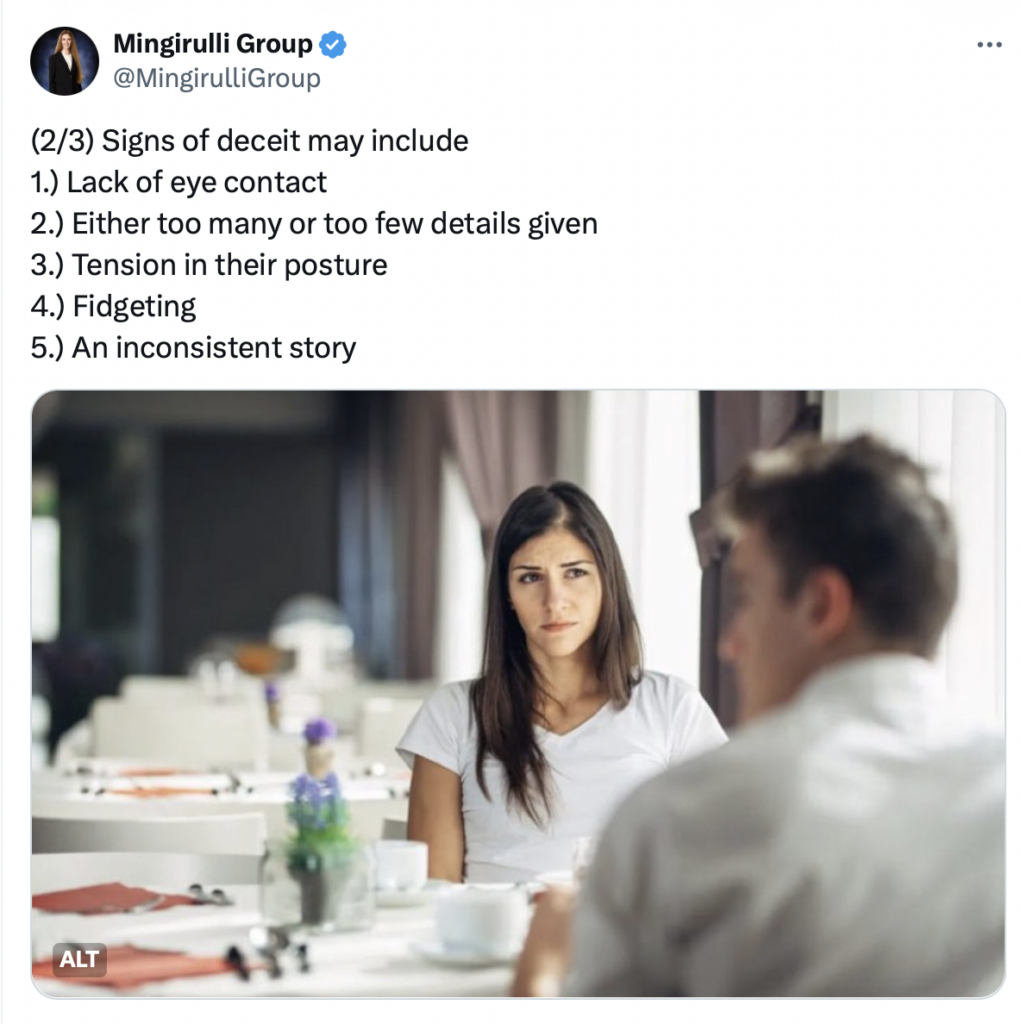
3.) Honesty vs. Dishonesty
Honesty is displayed through consistent and corresponding verbal and nonverbal signals. Honest individuals usually maintain steady eye contact, have open body language, and avoid excessive fidgeting. They also tend to provide clear and direct answers, and their tone of voice remains consistent. Honest people generally show fewer signs of stress, such as sweating or blinking excessively, when communicating. Additionally, they likely neither gloss over the story they’re telling nor give excessive details. Their stories also remain consistent when repeated.
Dishonesty, however, can be detected through inconsistencies between what is being said and how it is being communicated. Signs include avoiding eye contact, excessive blinking, fidgeting, and changes in voice pitch. Liars may also touch their face more frequently and use overly complex sentences to explain themselves. According to a study in the Journal of Behavioral Decision Making, liars often provide more details than necessary to make their story seem more believable. We’ve also found liars to skim over the details and have trouble telling a consistent story because they forgot what they told you initially.
Final Thoughts
Recognizing these emotional cues is a very valuable skill for improving your interpersonal interactions, both inside and outside the workplace. By paying attention to body language, facial expressions, and verbal patterns, you can better understand the true feelings of those around you.
Citations
1.) Adams, R. B., & Kleck, R. E. (2005). Effects of direct and averted gaze on the perception of facially communicated emotion. Psychological Science, 16(3), 214-219.
Link: https://journals.sagepub.com/doi/abs/10.1111/j.0956-7976.2005.00802.x
2.) Apple, W., Streeter, L. A., & Krauss, R. M. (1979). Effects of pitch and speech rate on personal attributions. Social Psychology Quarterly, 42(3), 275-281.
Link: https://www.jstor.org/stable/3033776
3.) Carney, D. R., Cuddy, A. J. C., & Yap, A. J. (2010). Power posing: Brief nonverbal displays affect neuroendocrine levels and risk tolerance. Journal of Applied Psychology, 95(3), 678-681.
Link: https://psycnet.apa.org/doi/10.1037/a0017815
4.) DePaulo, B. M., et al. (2003). Cues to deception. Journal of Behavioral Decision Making, 16(3), 263-290.
Link: https://onlinelibrary.wiley.com/doi/abs/10.1002/bdm.443
5.) Knapp, M. L., Hall, J. A., & Horgan, T. G. (2014). Nonverbal Communication in Human Interaction. Cengage Learning.
Link: https://www.cengage.com/c/nonverbal-communication-in-human-interaction-8e-knapp/9781133311591/
6.) Vrij, A. (2008). Detecting lies and deceit: Pitfalls and opportunities. Journal of Personality and Social Psychology, 94(1), 103-115.
Link: https://psycnet.apa.org/doi/10.1037/0033-2909.129.1.74